

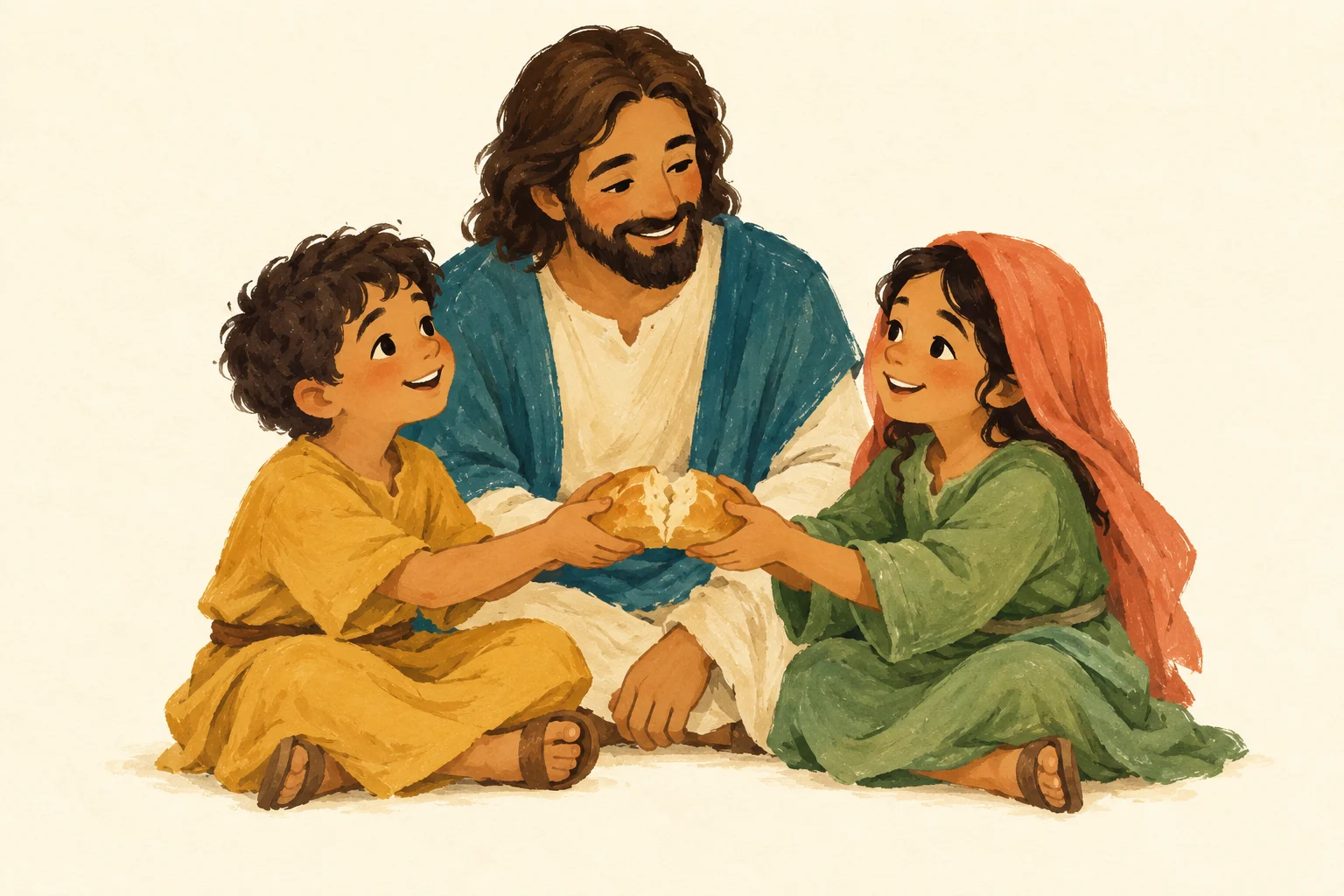
Children’s Church Lesson
Love God. Love Others.
October 25, 2026
Matthew 22:34–46
30–35 minutes
Wonder Truth
Jesus teaches us to love God and love our neighbors.
Big Idea
God loves us first. Because we are loved by God, we can learn to love Him with our whole lives and show that love by caring for other people.
Word of Wonder
“You shall love the Lord your God with all your heart, and with all your soul, and with all your mind.” — Matthew 22:37

Coloring Sheet
Print this one-page coloring activity for today’s lesson.
Download Coloring Sheet (PDF)Teach This Lesson
Open the section you are teaching. Each section includes its purpose, context, exact instructions, questions, adaptations, and transition to the next step.
How the Lesson Builds
Curiosity opens the question. Belief grounds it in Scripture. Faith rehearses a faithful response. Identity helps children connect truth with who they are becoming in God. Closing gathers the message into one truth, prayer, and next step.
Volunteer Prep – Read before children arrive
“You shall love the Lord your God with all your heart, and with all your soul, and with all your mind.” — Matthew 22:37
TODAY’S BIG IDEA
God loves us first. Because we are loved by God, we can learn to love Him with our whole lives and show that love by caring for other people.
LESSON SNAPSHOT
- Total Time: 30–35 minutes
- Prep Time: About 10 minutes
- Age Range: Kindergarten–5th Grade
- Goal: Children can name the two greatest commandments and one practical way to live each one this week.
- Main Passage: Matthew 22:34–46
SUPPLIES
- Bible or printed Matthew 22:34–40
- Large paper heart or poster paper
- Sticky notes
- Markers / crayons
- Construction paper or pre-cut hearts
- Child-safe scissors
- Glue or tape
- Optional: yarn
IF YOU ONLY HAVE 5 MINUTES TO PREP
- Read the Wonder Truth and Big Idea above.
- Read Matthew 22:34–40 once.
- Gather the supplies on this page.
- Skim the bold SAY / DO / ASK labels in each section.
- You do not need to memorize anything. Read naturally and make eye contact when you can.
DETAILED TEACHER PREPARATION
WHAT YOU NEED TO KNOW
Jesus is answering a question from someone who knows God’s law very well: Which commandment is greatest? Jesus joins two teachings already found in Israel’s Scriptures: love God with your whole self and love your neighbor as yourself.
For this lesson, the simple emphasis is: loving God and loving people belong together. Love is not only a feeling; love becomes visible in what we choose to do.
GRACE-CENTERED REMINDER
Do not teach this as “Be good so God will love you.” The Christian message moves in the opposite direction: God loves us first. We respond to God’s grace by learning to love God and others.
THEOLOGY NOTE
Jesus quotes Deuteronomy 6:5 and Leviticus 19:18. These commands come from the Jewish Scriptures and were already central to Jewish faith. Avoid presenting Jesus as replacing Judaism with something completely new; He is showing the heart of God’s law.
LEADER PRAYER
Loving God, thank You for loving us first. Help me make Your Word clear and welcoming today. Give me patience, warmth, and confidence. Help every child know they are deeply loved and that Your love can shape the way they treat others. Amen.
3-MINUTE ROOM SETUP
- Put the large paper heart where everyone can see it.
- Divide it into LOVE GOD and LOVE OTHERS.
- Put sticky notes and markers nearby.
- Place craft supplies together for later.
- Open your Bible to Matthew 22:34–40.
- Take one slow breath. You are ready.
YOU’VE GOT THIS
You do not have to sound like a professional teacher. Be warm, be clear, and keep moving. If a child gives an unexpected answer, thank them for sharing and gently connect the conversation back to the Wonder Truth.
Curiosity – 5 minutes | Get them wondering
5 MINUTES | GET THEM WONDERING
PURPOSE
Help children recognize that love is something we can see through actions, not only something we say.
AS CHILDREN ARRIVE
Give each child a sticky note. Ask them to draw or write one thing a person can do to show love. Have them place it anywhere on the large heart.
LEADER SAYS
“Hi! I’m glad you’re here. Before we start, think of one way someone can SHOW love. You can write it or draw it on your sticky note and add it to our heart.”
IF STUCK
Offer one of these choices: helping someone, sharing, listening, giving a hug when appropriate, praying for someone, including someone, or saying something kind.
LEADER SAYS
“Look at all these ideas. We usually say things like ‘I love you,’ but love is also something people can see through our choices. If I say I love someone but I am always mean to them, my actions and my words do not match very well.”
ASK
How can someone tell that you care about them even if you never say the words “I love you”?
LISTEN FOR
Helping, listening, sharing, spending time together, protecting someone, encouraging, forgiving, including, or caring for them.
IF QUIET
Ask: “Which shows love more: helping a friend who fell down, or laughing at them? Why?”
ADAPT
- K–2: Keep answers concrete. Ask: “What could your hands do to show love?” or “What could your words say?
- Grades 3–5: Ask: “Can someone say loving words but make unloving choices? What would that look like?
TRANSITION
“Today someone asks Jesus a huge question: ‘Out of everything God has taught us, what matters most?’ Listen closely for the two things Jesus says.”
VOLUNTEER HELP
- Short on time: Skip reading the sticky notes aloud. Point to the heart, connect love to action, and move on.
- Extra time: Invite three children to act out a loving action while the group guesses.
- Remember: Keep this section moving. Curiosity should open the door, not become the whole lesson.
Belief – 10 minutes | Hear God’s Word
10 MINUTES | HEAR GOD’S WORD
PURPOSE
Help children understand the two greatest commandments and why Jesus connects loving God with loving people.
PRAYER OF INVITATION
“God, thank You for giving us Your Word. Help our ears listen, our minds understand, and our hearts learn Your loving way. Amen.”
BIBLE STORY — READ THIS NATURALLY
SAY THIS
“One day, Jesus was answering a lot of difficult questions. Some people truly wanted to learn, and some people were testing Him. A man who knew God’s law very well asked Jesus, ‘Teacher, which commandment in the law is the greatest?’ That was a BIG question. God had given His people many instructions about worship, justice, honesty, relationships, and caring for others. Which one would Jesus choose?”
PAUSE + ASK
“What do you think Jesus might say is most important?” Take two or three answers. Do not correct guesses yet. Say, “Those are thoughtful ideas. Let’s hear what Jesus said.”
CONTINUE THE STORY
“Jesus answered with words God’s people already knew from Scripture: ‘You shall love the Lord your God with all your heart, and with all your soul, and with all your mind.’ Jesus said this is the greatest and first commandment. Then He gave a second one: ‘You shall love your neighbor as yourself.’ Jesus said that everything God had taught His people hangs on these two commands.”
MAKE IT SIMPLE
“If we put Jesus’ answer into very simple words: LOVE GOD. LOVE PEOPLE. Loving God means we trust Him, pray, worship, listen to His Word, thank Him, and choose His way. Loving our neighbor means we notice people, help them, tell the truth, include them, forgive, encourage, protect people from cruelty, and treat them with dignity.”
IMPORTANT
“Jesus did NOT say, ‘If you love perfectly, then God will finally love you.’ God loves us first. We learn to love because God is already loving us and changing us.”
BELIEF — CONTINUED
ASK • PRACTICE • REMEMBER
ASK
Why do you think Jesus connects loving God with loving people?
LISTEN FOR
God loves people; people matter to God; our actions toward people can show what we believe; following God affects how we live.
IF QUIET
“Imagine someone says, ‘I love God!’ but then spends all day being cruel to everyone. Would those two things seem to fit together? Why or why not?”
WORD OF WONDER
“You shall love the Lord your God with all your heart, and with all your soul, and with all your mind.” — Matthew 22:37
TEACH THE MOTIONS
- LOVE — cross hands over your heart.
- LORD YOUR GOD — point upward.
- HEART — touch your heart.
- SOUL — sweep hands from head toward feet.
- MIND — point gently toward your head.
PRACTICE
- 1. Say it slowly together.
- 2. Say it again with motions.
- 3. Say it one final time without the leader saying it first.
CHECK FOR UNDERSTANDING
- What question did the man ask Jesus? — Which commandment is greatest?
- What did Jesus say first? — Love God with your whole self.
- What did Jesus say second? — Love your neighbor as yourself.
- Does love only mean having a nice feeling? — No. Love also shapes our actions.
TRANSITION
“We know what Jesus said. Now let’s practice what those words could look like when real life gets messy.”
VOLUNTEER HELP
- Short on time: Tell the story, teach “Love God. Love People.”, practice the verse once, and move on.
- Extra time: Name one way to love God with heart, mind, and everyday choices.
- Remember: If answers wander, bring everyone back to: “Love God. Love People.
Faith – 7 minutes | Practice the truth
7 MINUTES | PRACTICE THE TRUTH
PURPOSE
Help children practice choosing loving responses in real-life situations.
HOW TO RUN IT
Read a situation. Ask for one loving response. Accept several ideas, then use the “Listen For” line to guide the group.
SCENARIO 1
“Your younger brother or sister breaks something you wanted to use.”
ASK: What could love look like?
LISTEN FOR
Speaking calmly, getting help, telling the truth about being upset without being cruel, forgiving after an apology.
SCENARIO 2
“A new student comes to school and does not know anyone.”
ASK: What could love look like?
LISTEN FOR
Saying hello, inviting them to sit with you, showing them where something is, introducing them to others.
SCENARIO 3
“A friend starts making fun of another child.”
ASK: What could love look like?
LISTEN FOR
Not joining in, saying it is not okay, including the child, telling a trusted adult when help is needed.
SCENARIO 4
“Someone apologizes after hurting your feelings.”
ASK: What could love look like?
LISTEN FOR
Listening, forgiving when appropriate, being honest that trust may take time, getting help if the situation is serious.
SCENARIO 5
“You notice someone at home is tired and has a lot to do.”
ASK: What could love look like?
LISTEN FOR
Helping without being asked, doing a chore, encouraging them, asking what would help.
SAFETY
“Loving someone does not mean letting them hurt you, keeping dangerous secrets, or staying in an unsafe situation. Sometimes the loving and wise thing to do is get help from a trusted adult.”
FAITH — WRAP UP
ADAPT • PRACTICE • TRANSITION
K–2 ADJUSTMENT
Give only two choices: “Would it be more loving to include the new child or ignore them?” Then ask why.
GRADES 3–5 ADJUSTMENT
Ask children to think of a situation from school, sports, home, or friendships and describe a loving response.
STOP — Don’t react too fast. THINK — What would be true and loving?
PRAY — Ask God for help.
CHOOSE — Do the next faithful thing.
Say the four words together: “STOP. THINK. PRAY. CHOOSE.”
TRANSITION
“Jesus does not only tell us what to do. He reminds us what kind of people we are becoming because God loves us.”
VOLUNTEER HELP
- Short on time: Use Scenarios 2 and 3 only, then teach STOP–THINK–PRAY–CHOOSE.
- Extra time: Let children create one additional scenario for the group.
- Remember: Praise thoughtful reasoning, not just the “right” answer.
Identity – 7 minutes | Activity and response
7 MINUTES | WHO AM I BECOMING?
TRUTH TO REMEMBER
I am loved by God. Because I am loved, I can learn to love God and others.
IDENTITY — ACTIVITY
LOVE GOD / LOVE OTHERS HEART
DO THIS
Give each child a paper heart or construction paper. Draw a line down the middle.
LEFT SIDE — LOVE GOD
Draw or write ways to love God: pray, worship, thank God, read or hear Scripture, trust God, care for creation, choose what is right.
RIGHT SIDE — LOVE OTHERS
Draw or write ways to love people: help, include, listen, share, forgive, encourage, protect, pray for someone, tell the truth kindly.
LEADER SAYS
“You do not have to earn God’s love by filling your heart with enough good things. God already loves you. This heart is a reminder of what God’s love can grow in us.”
ASK WHILE THEY WORK
What is one of these things that would be easy for you this week? What might be difficult? Who could help you practice it?
FINISH EARLY? On the back write or draw: “Someone I can encourage this week is ______.”
ADAPT
- K–2: Let children draw instead of write. Offer simple picture ideas: praying hands, a heart, helping hands, two friends, a smile, a Bible.
- Grades 3–5: Have children circle one action on each side and write one specific plan: “This week I will ______.
IDENTITY CONNECTION
“You are already loved by God. You are not trying to become good enough for Him to notice you. Because God loves you, you can keep becoming someone whose love is visible. Your hands, words, choices, courage, and kindness can all show God’s love.”
Leader: Who loves us first? Children: God loves us!
Leader: How can we respond? Children: Love God and love others!
Leader: Why can we love? Children: Because God loves us!
TRANSITION
“Let’s finish by remembering the one truth we want to carry with us all week.”
VOLUNTEER HELP
- Short on time: Skip cutting and decorating. Use plain paper and add one idea to each side.
- Extra time: Invite children to share one item from their heart.
- Remember: Craft time is still teaching time. Keep talking about the Big Idea.
Closing – 3–5 minutes | Send them with the truth
3–5 MINUTES | SEND THEM WITH THE TRUTH
WONDER TRUTH
Jesus teaches us to love God and love our neighbors.
SAY THIS
“Today Jesus gave us a simple way to remember the heart of faithful living: love God and love people. We do not do that so God will love us. God loves us first. His love helps us learn to love.”
QUICK REVIEW
- What did Jesus say is the greatest commandment? — Love God with all your heart, soul, and mind.
- What is the second? — Love your neighbor as yourself.
- Who counts as a neighbor? — Other people God calls us to treat with love and care.
- What is one loving action you can practice this week?
WORD OF WONDER
“You shall love the Lord your God with all your heart, and with all your soul, and with all your mind.” — Matthew 22:37
TAKE-HOME CHALLENGE
Each day this week: do one simple thing that helps you love God and one simple thing that helps you love another person. Tell someone at home what you chose.
CLOSING PRAYER
“God, thank You for loving us first. Help us love You with our hearts, our whole lives, and our minds. Open our eyes to people who need kindness, courage, help, forgiveness, or friendship. Help Your love become visible through our words and choices this week. Amen.”
DISMISSAL
As each child leaves, say: “You are loved by God. Go share that love.”
VOLUNTEER HELP
- If the group gets loud: Say, “Freeze and find my eyes.” Wait quietly, then repeat the Wonder Truth together.
- If no one answers: Give two choices or offer your own example first.
- If a child shares something serious: Listen calmly. Do not promise secrecy. Follow your church’s child-safety procedures and notify the appropriate ministry leader.
- If one child answers everything: Say, “Thank you. I want to hear from someone who hasn’t shared yet.
- If time runs short: Keep the Bible story, Wonder Truth, and closing prayer. Everything else may be shortened.
AFTER CLASS
Reset the supplies and room. Report any safety concern or important disclosure. Remember one thing that worked well.
Connection matters more than perfect execution. Be calm, caring, and point children toward Jesus.